
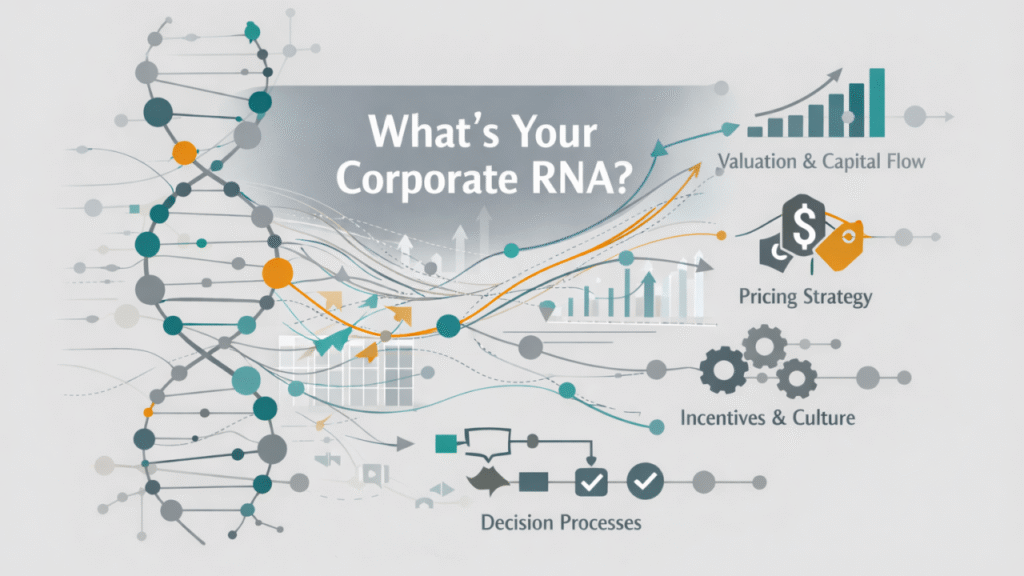
Data-Driven Narrative for Capital Formation in Life Sciences
The question “What is your corporate DNA?” has become ubiquitous in strategic discourse. Organizational theorists have operationalized this biological metaphor to describe the foundational elements – structure, decision rights, information flows, and incentive systems – that define an enterprise’s identity and drive its behavior. For biotechnology and pharmaceutical companies, corporate DNA encompasses scientific platform capabilities, intellectual property portfolios, organizational competencies, and strategic positioning.
Yet a fundamental problem persists: DNA, whether biological or organizational, is inert. It encodes information but cannot, by itself, produce functional output. The critical question for capital-intensive life science enterprises is not merely what their corporate DNA contains, but how that encoded value is expressed to external stakeholders – investors and strategic partners – who control access to capital and collaboration.
The answer lies in a more complete application of molecular biology: the concept of corporate RNA.
The Molecular Basis of Value Expression
In cellular biology, deoxyribonucleic acid (DNA) serves as the repository of genetic information, encoding the instructions for protein synthesis. However, DNA remains sequestered within the cell nucleus and cannot directly participate in the protein-producing machinery of the cytoplasm. The Central Dogma of molecular biology describes the mechanism by which genetic information flows from DNA to functional protein: DNA is first transcribed into messenger RNA (mRNA), which then exits the nucleus and is translated by ribosomes into proteins—the functional molecules that enable cellular metabolism, growth, and survival.
This biological process provides a precise analogy for enterprise value creation and capital formation. Corporate DNA – the organization’s scientific assets, human capital, and strategic capabilities – represents encoded potential value. But potential value does not attract investment. Investors and strategic partners allocate capital based on their assessment of expressed value: the information that reaches them through corporate communications, data presentations, financial models, and market positioning.
Corporate RNA is the mechanism by which an enterprise transcribes its intrinsic value proposition and translates it into forms that capital providers can evaluate, price, and act upon. Effective corporate RNA is not merely narrative – it is data-driven narrative, grounded in rigorous analysis, validated by market evidence, and calibrated to the specific requirements of target audiences at each stage of company development.
Theoretical Foundations
The organizational DNA framework has been developed extensively in the management literature. Neilson, Pasternack, and Mendes (2003), in research conducted through Booz Allen Hamilton involving over 220,000 organizational assessments, identified four fundamental building blocks of organizational DNA: structure, decision rights, information, and motivators. Their framework demonstrates how these elements combine to create distinctive organizational phenotypes that determine execution capability and strategic outcomes.
Doerr (2018) extended this conceptual framework by documenting how the Objectives and Key Results (OKR) methodology became embedded in the organizational DNA of high-performing technology companies, including Google, Intel, and Amazon. His analysis demonstrates that sustainable competitive advantage derives not merely from possessing distinctive capabilities, but from systematically expressing those capabilities through aligned goal-setting and communication systems.
The corporate RNA concept integrates these organizational frameworks with capital markets theory. Information economics establishes that capital allocation efficiency depends on the quality of information flow between enterprises and investors. Agency theory highlights the challenges of aligning management and investor interests under conditions of information asymmetry. Signaling theory explains how corporate actions and communications convey credible information about unobservable firm quality. The common thread: data-driven communication reduces information asymmetry and improves capital allocation outcomes.
The Capital Formation Problem in Life Sciences
Biopharmaceutical development presents a distinctive capital formation challenge. Drug development timelines typically span 10-15 years from target identification to regulatory approval, with fully capitalized costs exceeding $2 billion per approved therapeutic. The probability of success from Phase I clinical trials to approval remains below 10% for most therapeutic areas. These characteristics – extended time horizons, substantial capital requirements, and high technical risk – create acute information asymmetry between company management and external capital providers.
Venture capital investors, corporate strategic partners, and institutional allocators must make decisions based on incomplete information about scientific validity, clinical feasibility, regulatory pathways, and commercial potential. Their assessment frameworks rely on quantitative inputs: probability-weighted revenue forecasts, risk-adjusted net present value models, comparable transaction benchmarks, and analog company performance data. The quality of corporate communication – the fidelity and analytical rigor of the corporate RNA – directly affects investor perception of risk-adjusted returns and, consequently, the cost and availability of capital.
Empirical observation suggests that many life science companies suffer from what might be termed expression deficiency: their corporate DNA encodes substantial scientific and commercial potential, but their corporate RNA fails to translate that potential into the data-driven frameworks that investors and partners require. Stories without supporting models lack credibility. Models without compelling narrative lack memorability. The result is valuation discount, suboptimal capital structure, and constrained strategic optionality.
The Architecture of Data-Driven Narrative
Effective corporate RNA integrates three essential components: analytical foundation, narrative construction, and audience calibration. Each component requires specialized expertise and systematic methodology.
Analytical Foundation. Credible investor communication begins with rigorous quantitative analysis. This includes financial modeling that captures the economics of drug development—R&D expenditure trajectories, clinical trial costs, manufacturing scale-up requirements, and commercial infrastructure investment. It requires market research that quantifies addressable patient populations, competitive dynamics, pricing and reimbursement landscapes, and adoption curves. It demands forecasting methodologies that translate clinical and regulatory scenarios into probability-weighted revenue projections. Without this analytical substrate, corporate narrative reduces to assertion without evidence.
Benchmarking and Comparables. Investors evaluate opportunities in relative terms. What comparable transactions have occurred in this therapeutic area? How have analog companies performed at similar stages of development? What valuation multiples has the market assigned to comparable assets? Systematic identification and analysis of relevant comparables – transaction comps, trading comps, and operational analogs – provides the evidentiary basis for valuation assertions and strategic positioning. This benchmarking discipline ensures that corporate narrative aligns with market-validated reference points rather than aspirational assumptions.
Narrative Construction. Data alone does not persuade. The analytical foundation must be synthesized into a coherent value proposition that addresses the specific questions investors and partners ask: Why this target? Why this approach? Why this team? Why now? Effective narrative construction translates complex scientific mechanisms into accessible investment theses, positions clinical data within competitive context, and articulates clear value creation pathways tied to identifiable milestones. The narrative must be compelling without overstating, differentiated without misrepresenting, and memorable without sacrificing precision.
Audience Calibration. Different stakeholders require different expressions of the same underlying value. Venture investors focus on team quality, platform optionality, and exit potential. Strategic partners evaluate scientific fit, commercial synergies, and integration complexity. Public market investors demand revenue visibility, margin trajectories, and earnings predictability. Effective corporate RNA adapts the analytical emphasis and narrative framing to the decision criteria of each target audience while maintaining consistency in underlying assumptions and strategic positioning.
Stage-Specific Expression Requirements
Biological systems regulate gene expression dynamically, producing different proteins in response to developmental stage and environmental conditions. Corporate RNA must similarly adapt to the specific analytical and narrative requirements of each phase in the biopharmaceutical value chain.
Discovery and Preclinical Development. At the earliest stages, corporate RNA must communicate scientific rationale, platform differentiation, and target product profiles to investors whose assessment necessarily relies on management credibility and scientific validation. The analytical foundation emphasizes target validation data, mechanism of action differentiation, and preliminary efficacy signals. Relevant benchmarks include comparable platform company valuations, historical financing terms for similar-stage assets, and precedent transactions in the therapeutic area. Forecasting at this stage focuses on development timelines, capital requirements to key inflection points, and scenario-based probability assessments.
Clinical Development. As programs advance into human trials, corporate RNA must translate clinical data into risk-adjusted value assessments. The analytical foundation expands to include detailed clinical trial design analysis, competitive enrollment dynamics, and regulatory pathway mapping. Benchmarking shifts toward clinical-stage transaction comparables, with particular attention to deal structures contingent on development milestones. Forecasting incorporates updated probability of technical and regulatory success (PTRS) estimates, refined commercial projections based on emerging efficacy and safety profiles, and sensitivity analyses around key clinical readouts. Each data release – positive, negative, or ambiguous – requires rapid recontextualization within competitive and regulatory frameworks.
Regulatory and Commercial Transition. Approaching approval and launch, corporate RNA must address commercial execution capability, market access strategy, competitive positioning, and revenue trajectory. The analytical foundation now emphasizes detailed market models incorporating epidemiology, diagnosis rates, treatment algorithms, pricing and reimbursement scenarios, and competitive share dynamics. Benchmarking focuses on launch analogs – comparable product introductions that inform adoption curve assumptions and peak revenue expectations. Forecasting transitions from probability-weighted scenarios to deterministic projections with explicit assumption documentation, supporting investor models that demand revenue and margin visibility.
Strategic Transactions. Throughout the development lifecycle, licensing opportunities, partnership discussions, and M&A approaches require corporate RNA capable of articulating asset value to counterparties with differing strategic objectives and valuation methodologies. Transaction-focused analytics include detailed comparable transaction analysis segmented by deal structure, stage, and therapeutic area; build-versus-buy analyses from the partner perspective; and synergy quantification frameworks. The narrative must adapt to address each counterparty’s specific investment thesis while maintaining valuation discipline and negotiating leverage.
Aligning Business Development Strategy with Investor Communication
A critical failure mode in corporate communication occurs when the story told to investors diverges from the strategy pursued in business development. Investors who fund a platform story expect platform-consistent partnering behavior. Strategic partners who engage based on specific asset narratives expect operational alignment with those narratives. Misalignment between communication and action destroys credibility and impairs future capital access.
Effective corporate RNA therefore requires tight integration between external communication and internal strategic planning. The same analytical foundation – the models, research, forecasts, and benchmarks – must inform both the investor presentation and the business development strategy. Valuation frameworks used to justify financing terms must be consistent with valuation expectations in partnership negotiations. Market positioning communicated to public investors must align with competitive strategies pursued in commercial execution.
This alignment discipline transforms corporate RNA from a periodic communication exercise into a continuous strategic capability. The analytical infrastructure developed to support investor engagement simultaneously informs internal decision-making: pipeline prioritization, resource allocation, partnership target identification, and transaction timing. Data-driven narrative becomes not merely a tool for external communication but a framework for strategic coherence.
RNA Advisors: Building Your Corporate RNA Capability
RNA Advisors provides life science companies with the specialized expertise required to develop robust corporate RNA—the systematic capability to translate scientific and commercial value into data-driven narrative for investors and strategic partners. Our practice integrates deep domain expertise in biopharmaceutical valuation with practical experience in investor supporting investor engagement, transaction support, and strategic positioning.
Our core methodology centers on building the analytical infrastructure that supports credible, consistent communication across all stakeholders:
Financial Modeling: Development of integrated financial models capturing R&D economics, commercial forecasts, and enterprise valuation under multiple scenarios. Models are constructed to investor-grade standards, with transparent assumptions and sensitivity analyses that anticipate due diligence scrutiny.
Market Research and Forecasting: Primary and secondary research to quantify market opportunities, characterize competitive dynamics, and develop defensible revenue forecasts. Forecasting methodologies are calibrated to stage-appropriate precision, avoiding false specificity in early development while providing requisite granularity as commercial launch approaches.
Benchmarking and Comparable Analysis: Systematic identification and analysis of transaction comparables, trading comparables, and operational analogs. Benchmark databases are maintained and updated to provide current market context for valuation discussions and strategic positioning.
Narrative Development: Translation of analytical findings into compelling investment theses and strategic narratives. Materials are developed for specific audiences—venture investors, strategic partners, public market participants—with appropriate emphasis and framing while maintaining analytical consistency.
Strategic Alignment: Frameworks and analysis to support management’s alignment of external communication with internal business development strategy, enabling consistency between investor messaging and partnership positioning. This analytical foundation supports credibility maintenance and negotiating leverage across relationships.
Our engagement model provides outsourced corporate development and business development support, enabling companies to access senior-level strategic and analytical capability without the fixed cost structure of permanent headcount. We partner with management teams to build sustainable corporate RNA infrastructure—not merely to prepare for a single transaction, but to establish the ongoing capability for effective capital markets communication throughout the company lifecycle.
Conclusion: From Encoded Value to Expressed Value
The biopharmaceutical industry’s capital intensity demands efficient information flow between enterprises and capital providers. Companies that develop robust corporate RNA—the systematic capability to transcribe intrinsic value into rigorous analysis and translate that analysis into compelling, audience-appropriate narrative—achieve more favorable capital access, improved transaction terms, and enhanced strategic flexibility.
Corporate DNA defines what an enterprise is. Corporate RNA—built on models, research, forecasts, and benchmarks, expressed through data-driven narrative—determines what an enterprise can become by enabling the capital formation and strategic partnerships required for growth and value realization.
RNA Advisors partners with life science companies to build this critical capability, ensuring that the value encoded in your corporate DNA is rigorously analyzed, compellingly communicated, and strategically aligned—expressed effectively to the investors and partners who can provide the resources necessary for your mission.
_______________
References
Organizational DNA and Strategic Communication:
Neilson, G.L., Pasternack, B.A., & Mendes, D. (2003). The Four Bases of Organizational DNA. Strategy+Business, 32, 48-57.
Neilson, G.L. & Pasternack, B.A. (2005). Results: Keep What’s Good, Fix What’s Wrong, and Unlock Great Performance. New York: Crown Business.
Doerr, J. (2018). Measure What Matters: How Google, Bono, and the Gates Foundation Rock the World with OKRs. New York: Portfolio/Penguin.
Biological Metaphors in Organization Theory:
Faghih, N., Babakhani, A., & Salehi, M. (2016). Biological Metaphor and Analogy upon Organizational Management Research within the Development of Clinical Organizational Pathology. QScience Connect, 2016(1), 4.
Mars, M.M. & Bronstein, J.L. (2018). The Promise of the Organizational Ecosystem Metaphor: An Argument for Biological Rigor. Journal of Management Inquiry, 27(4), 382-391.
Molecular Biology:
Alberts, B., Johnson, A., Lewis, J., et al. (2002). From DNA to RNA; From RNA to Protein. In Molecular Biology of the Cell (4th ed.). New York: Garland Science.
Crick, F. (1970). Central Dogma of Molecular Biology. Nature, 227(5258), 561-563.
Information Economics and Capital Markets:
Akerlof, G.A. (1970). The Market for “Lemons”: Quality Uncertainty and the Market Mechanism. Quarterly Journal of Economics, 84(3), 488-500.
Spence, M. (1973). Job Market Signaling. Quarterly Journal of Economics, 87(3), 355-374.
