
A companion to our peer-reviewed paper in JPMSA Spring 2026.
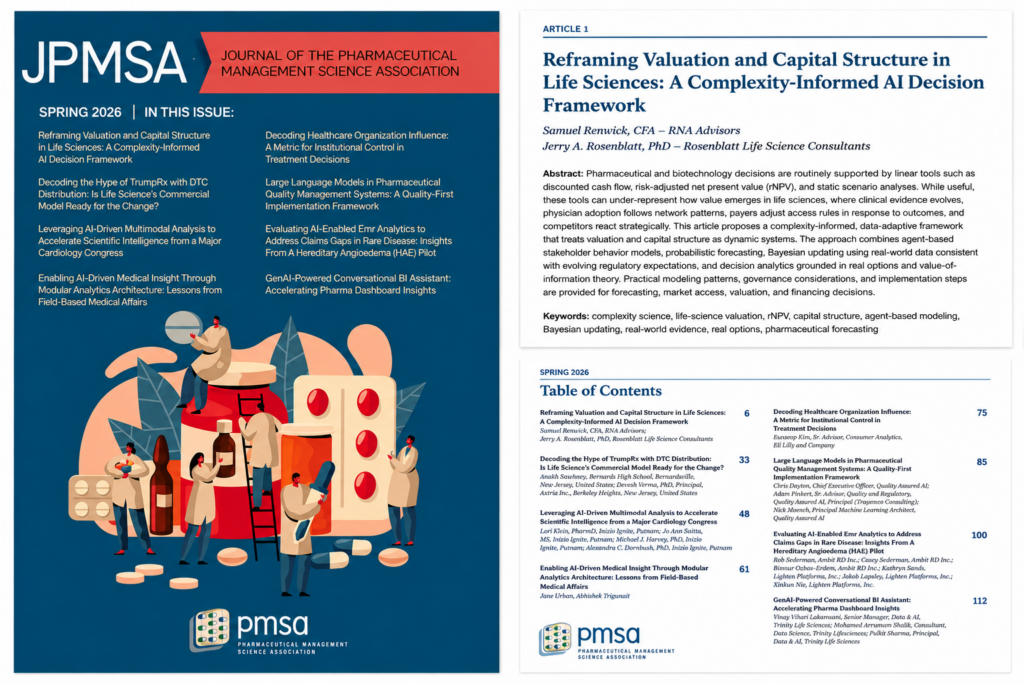
Two practitioners, opposite sides of the deal table, the same frustration.
We have known each other for some time. Our practices, though, have lived on opposite sides of the deal table for most of that time. Jerry has spent thirty years inside the largest pharmaceutical companies in the world, building forecasts and opportunity assessments that shape acquisition decisions. Sam has spent his career advising biotech founders, executives and venture investors on the other side of that conversation, structuring transactions, valuing assets and translating science into capital decisions.
You learn different things from each side. From the acquirer’s chair, you watch good science fail to translate into a commercial story that justifies the price the seller is asking. From the seller’s chair, you watch good science get compressed into a single number that no one on the other side actually believes. Both of us, in our own ways, have been frustrated for years by the same gap.
Venture math makes that gap impossible to ignore. The power-law distribution of biotech outcomes, where a small number of programs generate nearly all of the returns and most produce limited or negative value, is not a curiosity. It is the central fact of the industry. And yet the dominant valuation framework, rNPV with a few scenarios, treats that distribution as if it were a smooth average. It compresses bimodal, fat-tailed reality into a single number that is mathematically defensible and behaviorally misleading. The “expected” value, in most cases, corresponds to no realistic outcome at all.
We reconnected on a project that required honest conversation about exactly this problem. Each of us, looking at the same asset from opposite sides of a transaction, found that the standard tools were producing answers neither of us trusted. The dialogue that followed was the most candid version of a conversation we had each had separately, in our own firms, for years. We started writing.
The paper is what came out of those conversations. It is not a rejection of rNPV; it is an argument that rNPV, on its own, hides more than it reveals. The framework we propose, complexity-informed valuation, treats the asset, its market and its capital structure as a connected adaptive system. It accepts the power-law nature of life-science returns rather than averaging it away. It values managerial flexibility rather than assuming a committed pathway. And it updates assumptions as evidence accumulates rather than freezing them at the model date.
This is the first piece of a longer arc. Empirical validation, case studies and the integration of generative AI into the Bayesian pipeline are next. And that’s just the math. How also does one map negotiating leverage and agency issues into negotiations when combining math and finance theory with psychology in these strategic decision contexts?
For now, we wanted to share the origin: two practitioners, looking at the same problem from opposite sides, finding the same answer.
Samuel Renwick, CFA · RNA Advisors
Jerry A. Rosenblatt, PhD · Rosenblatt Life Science Consultants
