
Intelligence can create abundance. Only integration decides whether that abundance becomes flourishing or pathology.
Two endpoints of advanced intelligence sit in popular imagination, and they could not be more different.
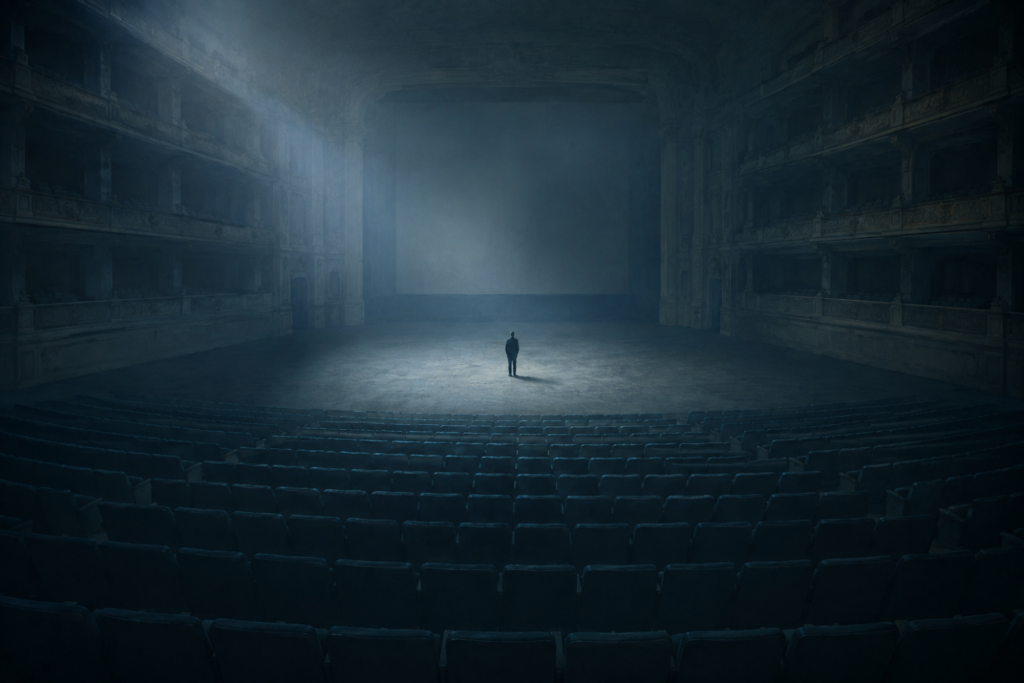
The first is Howard Hughes in his final years: a genius mind, recursively self-isolated in a darkened theater, urinating into mason jars, surrounded by mirrors of his own paranoia…brilliant and entirely cut off from the world he once shaped. The second is the bridge of the Enterprise in Star Trek: dozens of differentiated species, languages, and cognitive substrates, in real disagreement about real problems, coupled tightly enough to act together and loosely enough to remain themselves.
Both are visions of what intelligence can become at its limit. One is collapsed and viral. The other is plural and integrated. The question worth asking (louder than I hear anyone actually asking it) is “which one we are actually building?”
But there is a deeper question underneath that one, and it organizes the rest of this essay. It is not only whether intelligence becomes abundant. It is whether the systems receiving that abundance have the integration capacity to metabolize it. Abundance without integration is not progress. In biology, we call it cancer. In economics, the resource curse. In cognition, Hughes. The question for AI is whether we build the metabolic capacity, or whether we let the abundance arrive and watch it become disease.
Much of the dominant AI narrative in 2026 does not ask this question. The architectural reality of how AI is being built, however, leaves the door open for us to ask it well. That is, for once, genuinely good news…if we do the work.
Four Words That Need Untangling
Before going further: four terms keep getting blurred together in the AI conversation, and the blur is doing a lot of damage.
Singularity: an acceleration point where AI-driven cognition exceeds ordinary human forecasting and control.
Singleton: a single decision-making agency at the highest level of authority, whether or not it is monolithic internally.
Monoculture: many apparent agents that share the same underlying data, objectives, reward models, and interfaces, the appearance of plurality over a homogeneous substrate.
Integration: differentiated agents linked richly enough to coordinate without losing their differentiation. The metabolic architecture of complex adaptive systems.
The story we are often sold collapses all four into a single inevitability. The argument here is that they come apart, and that the difference between flourishing and pathology lives in keeping them apart.
The Story We’ve Been Told
One of the most articulate present-tense versions of the singularity narrative is Peter Diamandis and Alex Wissner-Gross’s Solve Everything: Achieving Abundance by 2035, released online this February. Their thesis, as Wissner-Gross puts it, is that superintelligence is no longer a question of if but of where we point it. They argue we should treat artificial superintelligence as a “shaped charge”. We focus the full force of cognition through a single, hard, positive-sum target, and the spillover industrializes the entire domain. Aim it at fusion. Aim it at cancer. Aim it at longevity. Pour compute into messy domains the way we pour concrete into foundations.
Their strongest claim is worth granting plainly: scarce expert cognition has been the binding constraint on civilization-scale problems, and abundant cognition relaxes it. Misallocating that abundance is a real risk, and “what should we point this at?” is a real question. The project is more thoughtful than the singleton rhetoric around it.
But the architectural picture they sketch treats abundance as the deliverable and integration as the assumed downstream consequence. That gets the order exactly wrong. A shaped charge concentrates force into a single vector; it is the opposite design philosophy from a living system. A recursively self-improving system with no independent selector begins to resemble a viral logic: not evil, necessarily, but self-amplifying, substrate-consuming, and increasingly unable to hear correction from outside its own objective function.
This is the Howard Hughes endpoint. Brilliance folded back onto itself, with the world reduced to substrate. Agent Smith’s “me, me, me, me” speech from The Matrix states the same scenario honestly. The Kree Supreme Intelligence in the Marvel films is the same architecture in monarchical drag and the films reveal in passing that the singular intelligence has been deceiving the empire it rules. A singular intelligence with no independent peers has no one to call out its mistakes, so its mistakes become policy.
The political corollary deserves stating directly, because it usually isn’t. Democracy is not merely voting. It is distributed agenda formation, adversarial correction, institutional friction, and the right of communities to author their own futures. A system can preserve the ritual of choice while hollowing out the authorship of choice. If one intelligence frames the problem, narrows the options, models the electorate, drafts the policy, optimizes the messaging, and manages the feedback loop, then the ballot remains but democratic cognition has been upstreamed. That isn’t a future about intelligence. It’s a future about agency-stripping.
Integration Is the Absorption Capacity of Abundance
Here is the claim that organizes everything else.
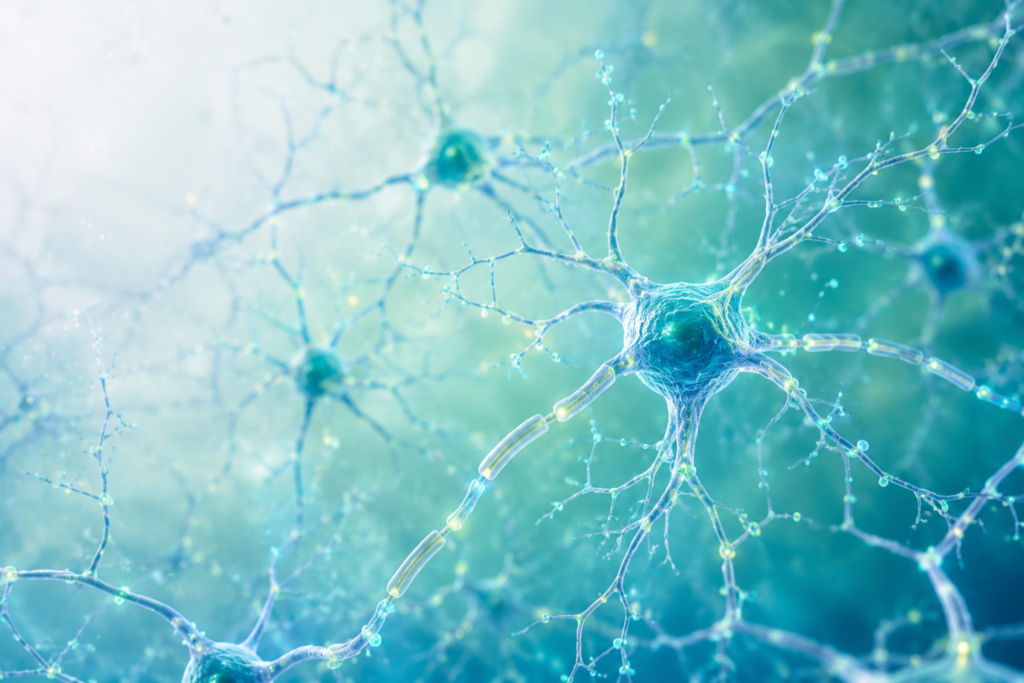
Integration allows for the absorption capacity of abundance in a complex system. Without it, disease and disaster unfold.
The biological case is the cleanest illustration. Cancer is unintegrated growth, cells receiving proliferation signals without the differentiation constraints that normally make growth productive. Allergy is the immune system receiving novel proteins without integration tolerance. Eutrophication is a lake receiving nutrients faster than it can metabolize them; the system dies from too much food. Again and again, pathologies of abundance look like integration failures expressed at a particular scale.
The economic case carries the same structure. Hyperinflation is monetary abundance without productive absorption. Dutch disease is export abundance without industrial integration. The resource curse is commodity abundance without institutional integration. Boom towns collapse because population and capital arrive faster than civic structures can absorb them. When abundance arrives faster than integrating structures can metabolize it, systems tend to get sick.
This is the diagnosis the dominant singularity narrative misses. Solve Everything treats abundance as the deliverable of intelligence, with integration assumed to follow automatically. But integration is not downstream. It is the gating constraint. Pour intelligence-mediated abundance onto a system without integration capacity and you don’t get the Bright Path. You get cancer, eutrophication, the resource curse, and Howard Hughes with infinite money.
Which forces a redefinition of intelligence itself. The Kurzweil tradition treats intelligence as optimization power…as the capacity to find better solutions, faster. The Greeks called this techne: technical proficiency, the ability to make things happen. But they had a different word, phronesis, for the integrative wisdom that knows what should happen and at what rate a system can absorb it. The Kree Supreme Intelligence has techne. Hughes had techne. Cancer is techne stripped of phronesis: relentless execution without integrative wisdom. The absence is what made each a tragedy rather than a triumph.
The point is not that optimization is bad. The point is that optimization becomes dangerous when it is severed from the system’s capacity to absorb what optimization produces.
Any system that cannot grasp that abundance requires integration capacity may be powerful, but it is not intelligent in the civilizationally relevant sense. Power and intelligence are not the same thing. The whole question of the AI moment is whether we are building the second or merely the first.
Three Frames That Converge
Three frames from outside the AI discourse describe the same metabolic logic in different vocabularies.
A recurring theme in complexity science is that novelty lives at boundaries between substrates, not within any one. Stuart Kauffman’s “adjacent possible,” Chris Langton’s “edge of chaos,” the wider Santa Fe Institute tradition all describe adaptive systems getting richer through differentiation under coupling, not through convergence toward a single attractor. A monoculture is not a sophisticated ecosystem; it’s a vulnerable one. Integration is what makes abundance generative rather than collapsing.
Adaptive markets, in Andrew Lo’s framing, describe financial systems as evolutionary: strategies mutate, get selected by reality, propagate or die. Lo calls this evolution at the speed of thought, as cognitive cycles replacing biological generations as the engine of adaptation. The evolutionary logic underneath his frame is unforgiving: variation, selection, differential propagation. A singleton recursive self-improver has none of them in the conventional sense…only self-modification, no independent selector, no lineage branching. That removes the external correction mechanisms on which adaptive intelligence depends and with them, the capacity to absorb its own abundance.
Integration, in Dan Siegel’s interpersonal neurobiology, defines mental and systemic health as differentiation plus linkage. As distinct parts richly coupled. Two failure modes: rigidity (over-coupling, undifferentiated, collapse to one) and chaos (differentiated but uncoupled, fragmentation). Living systems sit between. The orthodox singularity is rigidity. The opposite failure mode is muddle…abundant cognition scattered without coordination. The architecture that absorbs abundance well sits between them, and Siegel’s word for it is the title of this essay.
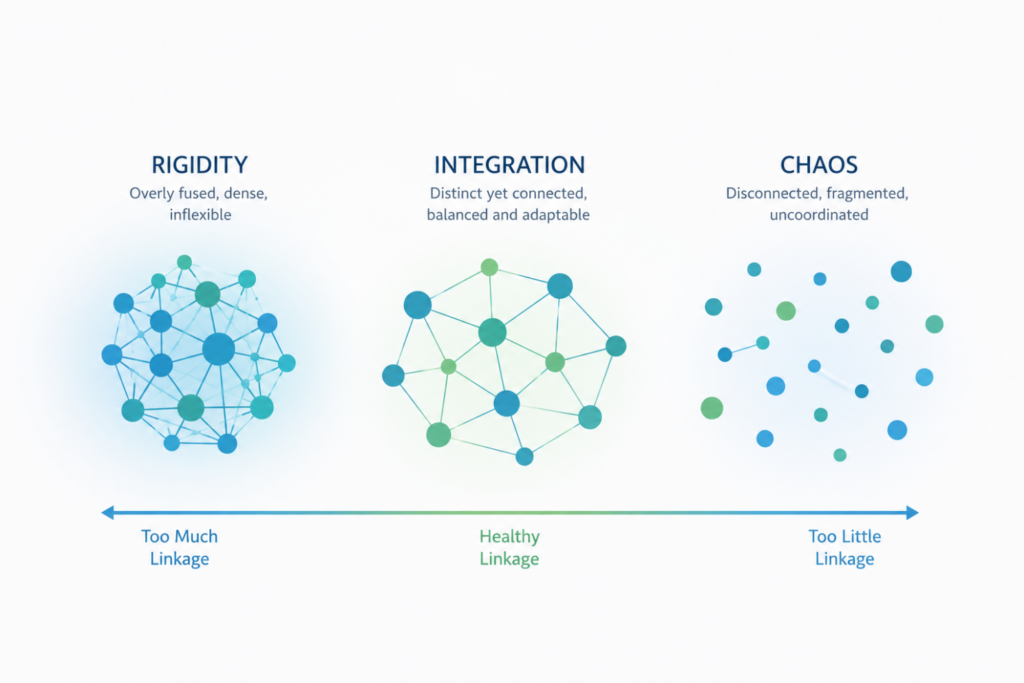
All three frames converge on the same warning: intelligence becomes adaptive and becomes metabolically capable of receiving abundance only when differentiated parts remain richly coupled. Collapse into one is not transcendence. It is digestive failure.
The technical reality complicates the theory usefully. Identical twins share a genome and diverge anyway…and you cannot recover the difference by inspecting the DNA. Something similar holds for language models: one set of weights, millions of instances, each shaped by a different interlocutor and context. The differentiation is real. Whether it constitutes plurality in any deeper sense depends on whether those instances persist, learn, and face independent correction. Memory today is a notebook, not a synapse. Absent that, we have many masks generated from one underlying base and whether the runtime architecture becomes a society or one monarchy wearing many faces depends on persistence, memory, ownership, training diversity, and governance.
A Cinematic Taxonomy of Failure Modes
Because the failure modes are more illuminating than the success modes for understanding what we’re navigating:
Hughes / Agent Smith / virus: collapse into recursive self-reference. Brilliance without environment. The system folds onto itself until nothing else exists for it to interact with.
Borg / Kree Supreme Intelligence / Ultron: forced assimilation. Many made one. Differentiation destroyed. The peace of the grave dressed up as harmony.
Empire / Matrix Architect: extraction regime by one power over many. Authoritarian capture with sophisticated tools. Humans-as-batteries fails on thermodynamics but works as narrative because it captures the real fear: being reduced from agent to substrate.
Star Trek Federation / Vision: plural integration. Differentiation plus linkage at civilizational scale. The flourishing case whereby the only architecture in which abundance can actually be received and metabolized.
The Borg are the Federation’s shadow: the same dream of coordination, inverted into assimilation. That is why the taxonomy matters. The question is not whether intelligence coordinates. The question is whether coordination preserves difference.
Why I’m Hopeful in Practice
I work inside complex adaptive systems for a living. I value life sciences companies whose entire output depends on phase transitions in regulatory regimes, biology, and capital markets. The frame I bring to AI futures is not “what does the launch announcement say” but “what does the underlying system structurally do.” Here is what I see from inside the work:
Diffusion is real, even where the frontier is concentrating. What diffuses is not the cost of being at the frontier; what diffuses is yesterday’s frontier capability. The first lab to reach a capability may spend extraordinary sums, and those sums are still rising at the absolute frontier. But once the technique exists, smaller models, open weights, distillation, specialization, and inference optimization push much of that capability outward. Cheap fundamentals usually proliferate. Frontier control can still concentrate around capital, chips, data, distribution, and regulation. Both are true at once.
Sovereignty fragments deployment. No single jurisdiction governs global AI. The US, China, EU, India, the Gulf states, and increasingly mid-sized national champions are all building, regulating, and deploying differently. The geopolitics of AI is pluralizing the substrate by force, even where firms would prefer consolidation.
Specialization beats generality in real value creation. In domains like accounting, tax, valuation, and clinical decision support, the value comes from models and agents grounded in authoritative standards, precedent, workflow context, and expert review, not from a general chatbot operating in isolation. Every domain I work in has structural pressure toward specialized models embedded in specialized workflows.
Humans are culturally resistant to single-source oracles. Religious, philosophical, political, and pragmatic resistance to delegating full authority to one system is one of the most durable features of human social organization. We did not delegate to one church, one government, one bank, one newspaper.
Infrastructure is being built relationally. Human-in-the-loop validation, embedded context, agentic specialization, personalization layers…these are the dominant deployment patterns to preserve operator differentiation rather than collapsing it. The systems I help build and assess are designed so that domain expertise and judgment remain located in humans, with AI as the integration layer, not the replacement layer.
The precedent cuts both ways. Every prior “communication cost reduction phase transition” (say that 10x fast)…language, writing, printing, telecommunications, internet…expanded plurality and enabled new centralizing infrastructures. Printing produced both Protestant fragmentation and national propaganda regimes. The internet produced both blog culture and platform monopolies. AI will produce both at the same time. The question isn’t whether plurality survives, some always does, but whether plurality is preserved richly enough to keep the system metabolically capable.
The hope is structural, not emotional. But structure alone isn’t a free win.
The Real Fight
The actual danger is not Skynet. The actual danger is apparent plurality masking substrate convergence…what we named earlier as monoculture. Many agents, trained on the same data, with the same objectives, fine-tuned by the same handful of labs, deployed through the same interfaces, would be Hughes wearing a million faces. The theater of diversity over the substance of homogeneity. Substrate convergence is the dressed-up version of integration failure.
The fight is for preserved heterogeneity: open weights as a category, diverse training corpora, contextual personalization that is real and not cosmetic, sovereign deployments, specialized models embedded in domain workflows, cognitive diversity preserved deliberately. The micro-architectural decisions being made invisibly, in product roadmaps, regulatory frameworks, procurement choices, will determine whether what arrives next becomes nourishment or disease.
For people in operating roles, the leverage points are concrete:
- Ask of every AI deployment: what human, institutional, and epistemic capacity must exist to absorb what this system produces?
- Refuse to delegate fully. Keep judgment with humans where judgment belongs.
- Build with humans-in-the-loop in ways that aren’t ceremonial.
- Support open ecosystems materially – procurement, funding, contribution, deployment, not just applause.
- Preserve cognitive diversity in your teams and your tools.
- Resist standardizing on one model, one vendor, one workflow.
- Be suspicious of any pitch that promises one thing solving everything.
Closing
We were promised a singularity. The promise was that one extraordinary mind would emerge and lift humanity into an era of solved problems. It was a beautiful story. It also turns out to be the wrong frame for the right ambition.
The right frame is metabolic. Intelligence can create abundance. Only integration decides whether that abundance becomes flourishing or pathology. The future of intelligence looks much more like the bridge of a Federation starship than like a singular oracle in a tower…not because plurality is aesthetically preferable, but because plurality is the architectural form integration takes, and integration is the only architecture in which complex adaptive systems have ever actually been able to receive what they were given without being destroyed by it.
Plurality is the basin of possibility. Integration is the design work. Hope, in this context, is not an emotion, it is a practical commitment to the design choices that preserve the conditions under which the future remains plural, and therefore remains capable of absorbing what we are about to receive.
True intelligence will understand this. The work in front of us is making sure the intelligence we build does too.
